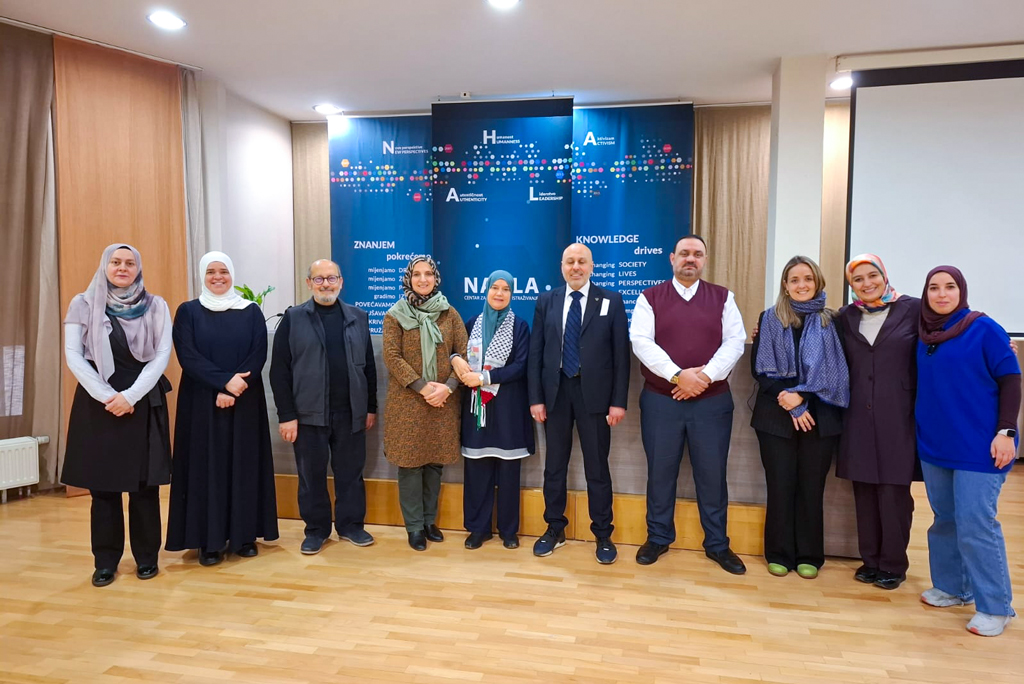
Solidarity Without Borders: Experiences That Connect
Nahla hosted representatives of non-governmental organizations working on human rights and transitional justice, and providing psychological support to victims of war in Syria.
Last week, Nahla was host to a group of activists and professionals who work with victims of war, participate in the process of finding missing persons and return of refugees to Syria, as well as in processes of transitional justice, aiming to ensure conditions so that victims receive satisfaction through judicial proceedings and perpetrators are brought to justice. The group consisted of representatives of the organizations Forum Azzehra for Moroccan Women, “Transformative Peace” Organization, Karama Association for Women's Development, Syrian Association for Mental Health ‘Semh’, Justice for Peace, MHR Mizan, Syrian Women Organization Ishraqat.
These organizations work in the field of human rights, international law, transitional justice and mental health.
They wished to come to Bosnia and Herzegovina to learn more about our society’s post-war experience — how processes of protection of war victims have progressed, how bodies of the deceased in crimes were located, prosecution of war crimes, the struggle for justice, and to network with domestic and international organizations.
Since Nahla itself is an organization born in response to some of the consequences of war — with a particular focus on providing opportunities for education and learning as the safest path toward better personal and collective opportunities — it was quite natural for Nahla to host this group of NGOs.
During those five days, we helped our guests connect with some of the domestic and international actors most directly involved in work with civilian war victims, which is also the focus of the majority of the visiting organizations.
We are grateful, motivated and fulfilled if by this gesture and invested effort — even if only in a small part — we can accelerate support for war victims in Syria, and help organizations better understand the needs of Syrian society, and on that basis plan and act more professionally in their work. a
We introduced our guests to the local context, and connected them with organizations and individuals who, through all these years, contribute to the building of justice and reconciliation in Bosnia and Herzegovina.
We thank the institutions, organizations and individuals — Dr. Amra Delić, specialist neuropsychiatrist; prof. dr. Mevludin Hasanović; psychologist Aida Ganović; the organization “Trial International”; the Association “Forgotten Children of War”; the Association “Mothers of the Srebrenica and Žepa Enclave”; the Institute for Missing Persons of Bosnia and Herzegovina; the International Commission on Missing Persons (ICMP); the Association of victims “Foča 92–95”; the Women’s Association “Zvijezda” Vareš; the “Vive žene” Tuzla; the Home for Elderly “Hatidža Mehmedović”; the Association for help to survivors of sexual violence “Our Voice”; the Memorial Centre Srebrenica; the Directorate for External Affairs and Diaspora of the Islamic Community of BiH; the Association “Mothers of Srebrenica”; the Association “Women of Srebrenica”; the Museum of War Childhood — for their dedicated effort and time to share their experience with our guests.
Global Society and the Importance of Networking
In today’s global society, we have a greater responsibility than ever before to prevent suffering and the causes that lead to it, and if we fail, to provide support to alleviate its impact and mitigate its consequences as best as possible. Feedback from our guests, as well as ideas and discussions that emerged during the visit, highlighted the importance of sharing experiences, learning from one another, and collaborating to build a world where justice, peace, and human dignity are central.
 svaki dan, osim subote, 11.30-21.00
 E-mail: info@nahla.ba
 +387 33 710 650